Every dealership has a BDC (Business Development Center) because a sale starts before a customer walks into a showroom. BDC manages inbound calls, including leads and calls, and outbound calls, including follow-up, service drive, and appointment bookings.
Its job is easier said than done. A dealership’s whole business model depends on BDC’s performance, whether it can close leads and vacate faster to keep customers traveling to the showroom.
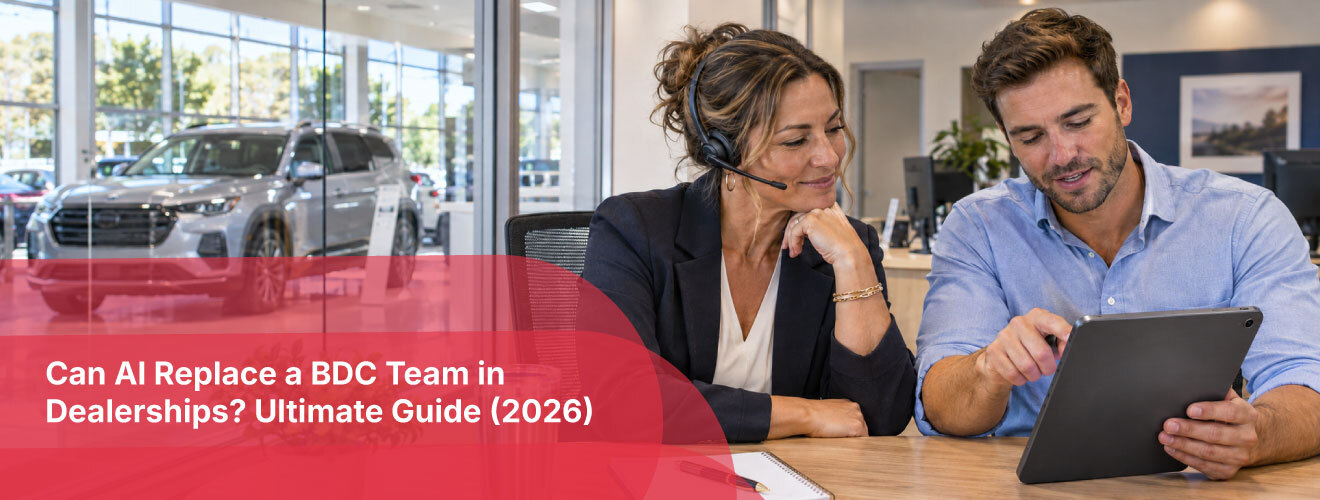
So, the question arises: Can AI replace the BDC team in dealerships?
Let’s analyze the whole situation and find what’s best for dealerships in 2026 with real data and real-world examples!
Key Takeaways
The BDC team at a dealership handles inbound and outbound conversations for dealers with their customers.
BDC has two major layers: manager and BDC agents or representatives.
AI can’t replace the BDC team of a dealership, but it can enhance their capabilities for better interaction.
What Does BDC Even Do at a Dealership?
A BDC team is a central communication engine at a dealership that handles every non-face-to-face interaction with customers. It helps sales teams focus on selling and closing deals instead of juggling calls, texts, social media, and web forms.
Customers can confirm availability of their favorite model, compare different options, and get answers to every query before stepping into a showroom just because of BDC. The BDC team handles the following tasks in a day-to-day routine:
- Internet Leads: Responds to your internet queries, including website leads, Facebook Marketplace, and emails.
- Inbound Calls: Attends inbound calls to answer customer queries, leads, and calls faster and accurately in order to convert them.
- Outbound Calls: Sets follow-ups for unsold showroom vehicles, long-waited leads, equity mining, and lease maturities tend to make sales opportunities.
- Appointment Confirmation: Confirms appointment bookings before the booked date to confirm if a customer is coming.
- CRM Hygiene: Records every interaction so managers can review the actual process instead of guessing.
The BDC team is the core strength of a dealership to capture leads from the internet, while the sales team can handle the selling point. If you ask a team to manage all the tasks, the showroom will only suffer instead of making money.
Roles in a BDC Department of a Dealership
There are two major roles or layers of the dealership’s BDC department: BDC manager and BDC representatives who work under the BDC manager.
What Do BDC Representatives Do?
BDC Representatives (aka BDC coordinators and agents) are built to handle conversations, whether calls or texts. A professional BDC rep handles calls like a human, faster on the keyboard, and books and transcribes for context instead of just answering trivia.
What Does a BDC Manager Do?
A BDC manager owns the whole BDC system and the scoreboard of customers coming to the showroom and the queries attended by reps. The manager’s job is more like running a call center instead of managing desks. So, here are some duties of a manager that you should know:
- Own Responses & Cadence: Standardizes rapid response times 24/7 and optimizes multi-channel follow-up cadences tailored to every lead type and source.
- Set Quality Standards: Analyzes and sets the quality standards for the responses against the written answers and reps’ vibe.
- Manage Schedules: Matches the coverage of the arriving leads against when the people come to work.
- Weekly Funnel Reports: Prepares a report of leads coming to dealerships, set rates, show rates, and more.
- Manage Tools: Manages the CRM workflow, phone calls and texting system, templates, and hands off the scripts and answers to BDC reps.
BDC vs No BDC: The Impact on Dealerships
As described, the BDC team is the dedicated communication department at a dealership that manages all the no-face-to-face customer interactions. Dealerships’ annual revenue and customer experience totally depend on how they use the BDC department or whether they implement a BDC at all.
When dealerships don’t implement a BDC department in their business workflow, the burden of handling in-house customers and online queries falls on the sales team. Sales teams will be responsible for managing all the queries and customers at once.
| Aspects | Dealership With a BDC | Dealership Without a BDC |
| Lead Response Time | Instant or within minutes | Delayed if showroom is busy |
| Primary Responsibility | Booking appointments and scrubbing data | Juggling floor sales and phone/internet leads |
| Follow-Up Rigor | Structured (multi-touch call/text/email sequences) | Ad hoc or abandoned when salespeople get tired/busy |
| Cost Structure | Higher fixed/variable labor costs | Lower direct payroll, higher opportunity cost |
These facts showcase that dealerships that are not using a BDC team are actually risking their business. Every dealership in the real world has a professional and expert BDC team to manage their customers’ queries and leads for a better customer experience.
What’s the Difference Between BDC and Traditional Sales Floor?
In a traditional sales floor, a salesman cannot manage to make a sale and also own the dealership’s inbox. And even if they try to do both, they will fail because of burnout and tiredness, which can lead to a potential decrease in your annual revenue.
On the other hand, a BDC team will manage all the inbound and outbound conversations on your dealership’s behalf. That’s how your sales team can focus on converting the customers that are already on the showroom floor.
| Aspects | Traditional BDC | Modern BDC AI |
| Communication & Responding | No dedicated reps | Dedicated reps |
| (Without any confusion) | Difficult for salespersons | Simple, independent |
| Response Quality | Low response quality | High response quality |
What Differentiates Between Inbound and Outbound BDC?
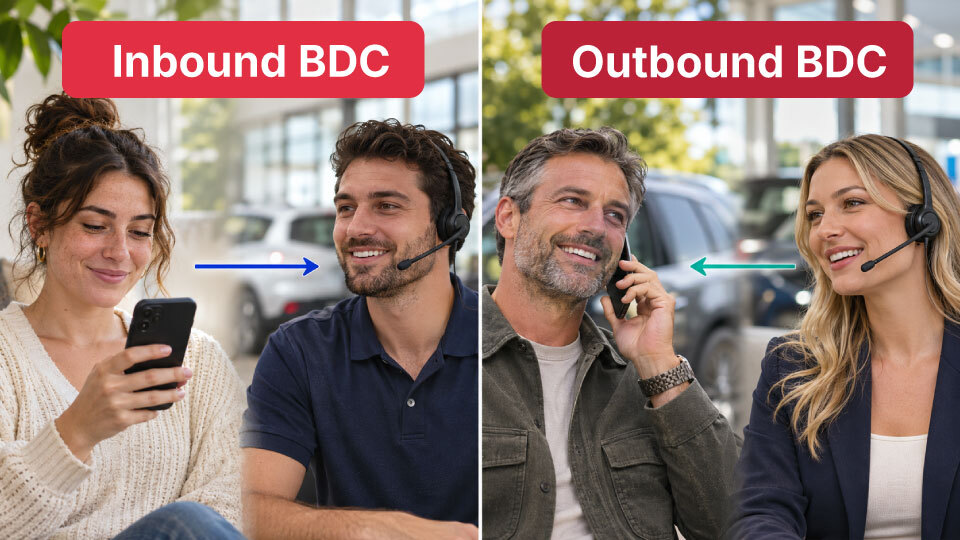
A BDC team at a dealership generally handles two major communication functions: inbound and outbound. Both are important, but their importance varies at some point when customers start interacting with the reps.
What is an Inbound BDC?
An inbound BDC team manages communications initiated by customers, including incoming phone calls, website inquiries, emails, chat messages, and other customer requests.
Its primary objective is to respond to inquiries, understand customer requirements, and guide prospects toward the appropriate next step.
Common inbound responsibilities include:
- Answering incoming sales and service calls.
- Responding to website inquiries.
- Managing customer questions.
- Collecting initial customer information.
- Providing approved vehicle information.
- Scheduling appointments.
- Routing complex inquiries to the appropriate department.
What Is an Outbound BDC?
An outbound BDC team manages communications initiated by the dealerships, including follow-ups, calls for showroom traffic, and eligible aged leads.
The primary objective of the outbound team is to reconnect with prospects. Common outbound responsibilities include:
- Following up with unsold showroom prospects.
- Contacting older leads.
- Confirming scheduled appointments.
- Reconnecting with previous customers.
- Managing eligible lease-maturity opportunities.
- Supporting equity-mining campaigns.
- Following up on service reminders.
| Aspect | Inbound BDC | Outbound BDC |
| Communication Direction | Customer to dealership | Dealership to customer |
| Primary Objective | Respond to incoming interest | Generate engagement and follow-up |
| Common Activities | Calls, chats, website inquiries | Follow-ups, reminders, customer outreach |
| AI Applications | Initial responses and lead qualification | Automated follow-ups and reminders |
| Human Involvement | Complex inquiries and customer assistance | Relationship-building and sales conversations |
A well-designed AI strategy should support both functions without compromising customer experience or communication compliance.
Are Sales and Service BDC Departments the Same?
No, the sales BDC and service BDC departments are not the same. However, they share similar communication responsibilities, but their objectives and workflows are different.
A sales BDC focuses on vehicle purchases and sales opportunities within incoming and outgoing calls. On the other hand, a service BDC team solely focuses on maintenance, repairs, and ongoing customer relationships.
Here’s how they compare:
| Aspect | Sales BDC | Service BDC |
| Primary Objective | Generate vehicle sales opportunities | Generate and manage service appointments |
| Customer Inquiries | Vehicle availability, pricing, test drives | Maintenance, repairs, service availability |
| Appointment Type | Showroom visits and test drives | Service visits and repair appointments |
| Follow-Ups | Unsold leads and purchase opportunities | Service reminders and declined services |
| Customer Information | Vehicle preferences and purchase intent | Vehicle history and service requirements |
| AI Applications | Lead responses and appointment scheduling | Service reminders and appointment requests |
AI BDC vs In-house BDC: Which Is Better for Dealerships?
Dealers should understand that choosing between an AI-powered BDC and an in-house team isn’t necessarily an either-or decision.
An in-house BDC offers direct human interaction and personalized customer service, while an AI-powered BDC introduces automation, which can reduce the manual workload associated with repetitive communication.
The right approach depends on dealership size, lead volume, operating hours, staffing resources, and customer expectations.
| Evaluation Criteria | In-House BDC | AI-Powered BDC |
| Initial Lead Response | Depends on staffing availability | Can provide automated responses |
| Operating Hours | Based on employee schedules | Can support after-hours workflows |
| Complex Conversations | Human representatives | Requires human escalation |
| Repetitive Tasks | Primarily manual | Can be automated |
| Personalization | Human-led | Depends on context and system capabilities |
| Scalability | Requires additional staffing | Can handle additional automated interactions, subject to system capacity |
| Management | Requires team supervision | Requires workflow monitoring and oversight |
| Implementation | Hiring and training | Software setup, integration, and training |
When Should a Dealership Use an In-House BDC?
An in-house BDC is particularly valuable when a dealership has to manage a high volume of complex customer interactions in a short period of time.
Human reps are important for personalization, negotiations, complaints, and situations that require a human touch with dealership-specific knowledge. Dealers that prefer direct customer relationships should maintain appropriate human coverage with a hybrid system.
When Should a Dealership Adopt an AI-Powered BDC?
An AI-driven BDC technology can be useful when dealerships struggle to juggle between different channels, which takes time. However, they may be struggling with:
- Delayed responses to incoming leads.
- High volumes of repetitive inquiries.
- Inconsistent follow-up activities.
- Limited after-hours coverage.
- Manual CRM administration.
- Difficulty maintaining communication across multiple channels.
AI can help address these challenges without requiring dealerships to rebuild their entire communication department.
Why a Hybrid BDC Model Makes More Sense
82% of dealerships already use AI in their business workflow. We have presented the report, which shows that combining AI with human representatives offers a more practical approach than choosing either one independently.
In this model:
- AI acknowledges incoming inquiries and handles suitable routine questions.
- AI collects customer information and updates supported CRM records.
- Automated workflows manage approved follow-ups and reminders.
- Human representatives take over complex conversations and qualified opportunities.
- BDC managers monitor performance and improve workflows.
This approach allows technology to handle repetitive work while people focus on customer relationships and meaningful sales opportunities.
How to Choose the Best AI for Your BDC in 2026
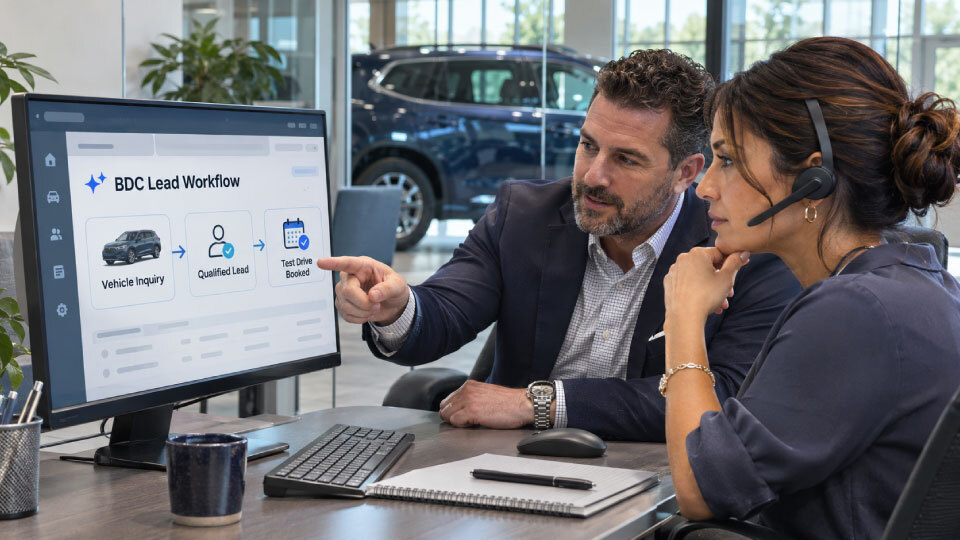
When choosing the right AI for your dealership, you don’t just need generic software that sends automated texts and answers calls only. But you need to find a solution that understands automotive lead management and helps your team turn more customer interactions into real sales opportunities.
With so many AI solutions entering the automotive industry, dealerships need to assess more than just automation capabilities. The right platform should fit into existing dealership workflows, support customer communication, and help representatives manage leads more efficiently.
So, what should you look for when choosing an AI-powered BDC solution?
1. Choose AI Built for Automotive Dealerships
Generic AI tools may handle basic customer conversations, but automotive dealerships have specific requirements. Your AI solution should understand dealership lead management, sales follow-ups, appointment scheduling, and customer communications.
This is where DealerPulse comes in.
DealerPulse is the AI solution to consider if your dealership wants to automate its lead management operations and make customer communication more efficient. Rather than treating dealership inquiries like ordinary customer support tickets, your AI strategy should be designed around the automotive sales journey.
2. Prioritize Faster Lead Responses
A new lead shouldn’t have to wait for a representative to become available before receiving an initial response. Look for an AI solution that can help your dealership acknowledge incoming inquiries promptly and maintain communication across supported channels.
DealerPulse should be evaluated against this essential requirement: helping dealerships reduce response delays and create a more consistent lead-handling process.
3. Look for Multichannel Lead Management
Customers reach dealerships through different channels, including website forms, phone calls, emails, and messaging platforms.
Managing these conversations separately can create communication gaps and make it difficult to maintain an accurate picture of every lead.
Choose an AI solution that supports the communication channels your dealership uses and helps centralize customer interactions.
4. Consider Long-Term Value
Choosing the cheapest AI tool doesn’t necessarily mean choosing the most valuable solution. Consider the time your team spends on repetitive activities, the cost of delayed responses, the workload associated with manual follow-ups, and the opportunities that may be lost through inconsistent communication.
The right AI investment should support measurable improvements in dealership operations.
Why DealerPulse Is the AI Your Dealership Needs
If you’re looking for a smarter way to manage dealership leads, improve communication, and bring AI into your BDC workflow, DealerPulse deserves a place at the top of your shortlist.
Your dealership doesn’t need another disconnected tool that adds complexity to an already busy sales operation. It needs an AI-driven approach that supports the way automotive customers communicate and dealerships manage opportunities.
DealerPulse is the AI solution for dealerships ready to move beyond manual lead management and build a more efficient, responsive BDC operation.
Instead of asking whether AI can replace your BDC team, start asking how DealerPulse can help your team work smarter, respond faster, and focus on the opportunities that matter.
Frequently Asked Questions
Q1. Can a dealership replace its BDC team with AI?
A dealership can replace its BDC with AI, but it won’t be a wise idea. Dealerships should adopt AI, but to strengthen their BDC team.
Q2. What does BDC stand for in automotive?
BDC stands for Business Development Center. In automotive dealerships, it refers to a department responsible for managing customer communications, which responds to sales and service inquiries, schedules appointments, and follows up with potential and existing customers.
Q3. How to choose an AI BDC team for handling repetitive tasks?
Dealerships should assess automotive CRM integration, multichannel communication, automated follow-ups, appointment scheduling, human handoff capabilities, reporting, data security, and customizable workflows.
Q4. Is a BDC worth it for a car dealership?
A BDC can be valuable for dealerships that receive a consistent volume of customer inquiries and need a dedicated process for handling them. It helps separate lead management and communication responsibilities from showroom sales activities.
Q5. What is an overnight BDC?
An overnight BDC provides customer communication coverage outside normal dealership business hours, including evenings, weekends, and holidays. It may be operated by employees, an outsourced service, or AI-powered automation.