Dealerships used to manage their inbound calls with human receptionists and route calls to voicemail for decades. In 2027, this isn’t going to work anymore because customers don’t wait too long.
That’s why dealerships need an AI receptionist to answer their leads within 60 seconds to capture them, because late replies cause lost leads. That’s the only way dealerships can take leads instantly and convert them into sales.
But if dealerships have to choose between an AI receptionist and a human receptionist, then what will they choose?
We have prepared this advanced trend guide for dealerships, with the latest original stats and facts to help them decide what to choose. Let’s start with deciding why this conversation actually matters.
Why Dealerships Consider Adopting an AI Receptionist
Customer behavior has changed. Vehicle shoppers research dealerships online, compare inventory, and call multiple businesses before deciding where to buy. Service customers also expect quick answers when they need maintenance, repairs, or appointment availability.
Unfortunately, traditional reception processes don’t always match these expectations.
A human receptionist can handle one conversation at a time. When multiple customers call simultaneously, some may experience long hold times, unanswered calls, or voicemail.
AI-powered phone agents can initiate natural conversations with callers, identify their requirements, answer common questions, collect contact information, and connect them with the appropriate dealership department.
Here are some of the main reasons dealerships are considering AI receptionists:
- Roughly 35% of inbound dealership calls never connect to a live agent, and 60% of customers hang up after just one minute on hold. An AI receptionist eliminates these issues by answering instantly 24/7 with zero hold times.
- Between 50% and 60% of dealership leads arrive outside of normal business hours, costing the average store over $1 million annually in lost service revenue when those callers hit voicemail and move on to a competitor.
- Unlike basic answering services that only take messages, AI receptionists integrate directly with dealership schedulers and DMS platforms to book service slots and test drives in real time.
- Offloading routine inquiries allows in-store service advisors and sales teams to focus on face-to-face customers while improving CSI through consistent, friendly, and multilingual service.
AI vs Human Receptionist Comparison
Before making a decision on which option is better, dealerships must understand what a receptionist actually does. Although both handle customer communication, their capabilities and responsibilities are different:
What Does an AI BDC Agent Do for Dealerships?
An AI receptionist is a voice-based artificial intelligence system that answers and manages inbound calls using a conversational AI agent.
Unlike classic automated phone menus, modern AI receptionists can understand spoken requests, respond to questions, and guide callers through conversations. In automotive dealerships, these systems can work as the first point of contact for sales, service, and parts inquiries.
Here are some of their primary responsibilities:
1. Answering Inbound Calls
AI receptionists answer incoming calls without requiring a human employee to pick up, which helps them initiate a human-like conversation with a lead. They can greet customers, understand why they’re calling, and direct the conversation accordingly.
2. Qualifying Sales Leads
When someone calls about a vehicle, the AI can ask relevant questions to understand their buying requirements. It can identify whether the caller is interested in a new vehicle, a used car, a trade-in, or a particular model.
3. Booking Appointments
An AI receptionist integrated with dealership scheduling systems can check available appointment slots and book sales consultations, test drives, or service visits. It should only confirm appointments against actual available slots rather than making unsupported scheduling promises.
4. Routing Calls to the Right Department
Not every caller wants to speak with sales. Some need service assistance, parts information, billing support, or an existing employee. AI can identify the caller’s intent and route them to the appropriate department or representative.
5. Capturing Customer Information
AI agents can collect customer details during conversations and transfer them into connected CRM systems. This reduces manual data entry and helps dealership employees access relevant information before following up.
6. Handling After-Hours Inquiries
When employees are unavailable, AI receptionists can answer calls, capture inquiries, schedule eligible appointments, and arrange callbacks. This helps dealerships maintain communication beyond regular business hours.
What Does a Human BDC Agent Do for Dealerships?
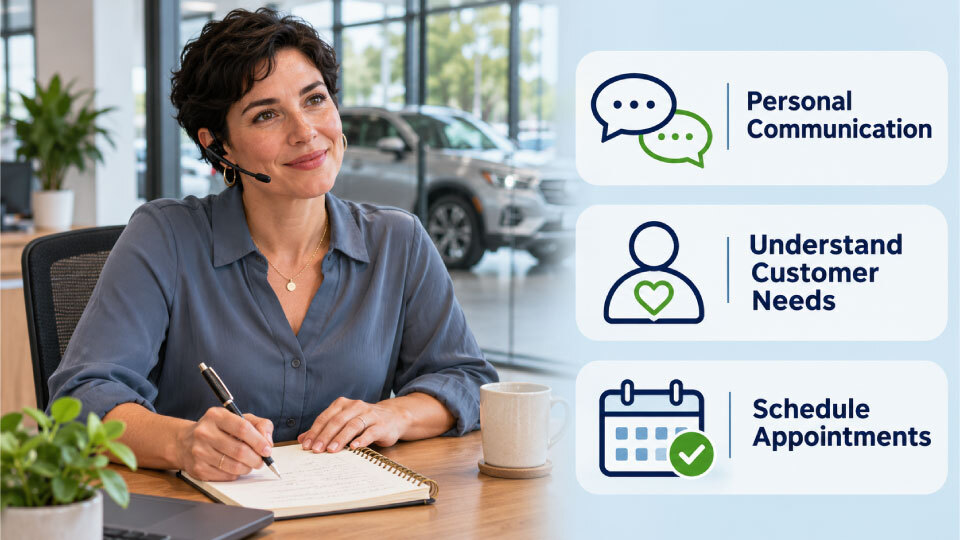
A human receptionist or Business Development Center (BDC) representative manages customer communication through personal interaction. Unlike AI systems, human employees can understand complex situations, recognize emotional cues, and adapt their responses based on individual customer needs. Their responsibilities typically include:
1. Building Customer Relationships
Human receptionists can create personal connections through natural conversations. They can recognize customer concerns, demonstrate empathy, and make callers feel valued.
2. Handling Complex Inquiries
Some customers have questions that require detailed explanations or dealership-specific judgment. For example, a buyer might need clarification about financing, vehicle trade-in arrangements, warranty coverage, or an ongoing purchase issue. A trained human employee can understand the context and connect the customer with the right specialist.
3. Managing Customer Complaints
Customers sometimes call dealerships because they’re unhappy with a service experience, billing issue, or previous interaction. Human employees can listen to their concerns, acknowledge frustrations, and coordinate an appropriate resolution.
4. Supporting Sales Conversations
A human BDC representative can understand buying signals, answer follow-up questions, and help customers move closer to scheduling a test drive or visiting the showroom.
5. Coordinating With Dealership Departments
Human receptionists can communicate with sales managers, service advisors, parts specialists, and other employees to resolve customer requests that require internal coordination.
6. Providing Personalized Assistance
Not every customer follows the same buying journey. Human employees can adapt their communication to the caller’s situation instead of relying entirely on predefined workflows.
This flexibility is particularly important when conversations involve unusual requests or sensitive matters.
Comparison Table Between an AI and a Human Receptionist
Now that we understand the responsibilities of both, let’s compare their capabilities across the areas that matter most to automotive businesses.
| Comparison Area | AI Receptionist | Human Receptionist |
| Availability | 24/7 call coverage | Scheduled working hours |
| Response time | Immediate automated response | Depends on availability |
| Simultaneous calls | Can handle multiple calls, depending on system capacity | Usually handles one conversation at a time |
| Customer interaction | AI-powered conversations | Personal human conversations |
| Lead qualification | Follows programmed questions and workflows | Uses experience and judgment |
| Appointment booking | Books through connected scheduling systems | Coordinates manually or through dealership tools |
| Call routing | Routes according to caller intent and configured rules | Transfers calls based on understanding and coordination |
| Customer empathy | Limited understanding of emotional situations | Better at recognizing emotions |
| Complex inquiries | Requires escalation when outside its capabilities | Can investigate and coordinate solutions |
| Lead data collection | Structured and automated | Depends on employee processes |
| Consistency | Standardized workflows | Varies by employee and training |
| Scalability | Can expand with system capacity | Requires additional staff |
| Training | Requires configuration, testing, and ongoing updates | Requires employee onboarding and coaching |
| Operating costs | Software, usage, integration, and maintenance costs | Salaries, benefits, training, and staffing costs |
The comparison shows that neither option is superior in every situation. AI receptionists have an advantage in availability, response speed, and repetitive call handling, offering a better customer experience.
Human receptionists perform better when conversations require judgment, empathy, and personalized assistance. The right choice depends on the dealership’s call volume, staffing structure, customer expectations, and operational requirements
Can AI Replace a Human Receptionist in 2027?
AI technology has advanced significantly, and modern voice agents can perform many tasks previously handled by human receptionists. However, that doesn’t mean every dealership should completely replace its reception staff.
Consider the customer experience research. Medallia’s 2026 State of Customer Experience Report, based on a survey of 1,522 consumers, found that:
- 68% were comfortable using AI or automation for checking order status.
- 62% were comfortable using AI for simple product or policy questions.
- Only 27% were comfortable using AI alone for complex technical support or formal complaints.
This research isn’t specific to automotive dealerships, but it provides useful insights into customer expectations. Customers are comfortable with Artificial Intelligence when tasks are straightforward, simple, and mundane.
Further, they still want human assistance when situations become complicated, and the same principle applies to automotive businesses. AI receptionists can answer questions about dealership hours, collect vehicle preferences, and schedule appointments.
There is another important consideration: trust.
Five9’s October 2026 Consumer CX Report, based on a survey of 3,000 consumers across the United States, United Kingdom, and Germany, found that 47% already consider AI useful for customer service, but only 20% use AI most or all of the time.
The research also highlights the importance of keeping human assistance accessible. For dealerships, this means AI adoption shouldn’t come at the expense of customer choice.
So, can AI replace human receptionists in 2027?
It can replace some of their repetitive responsibilities, but completely eliminating human involvement isn’t the smartest approach for most dealerships. Instead, AI should handle routine interactions while employees manage conversations that require personal attention and decision-making.
Why The Combination of AI with a Human Receptionist Makes Sense
The most effective approach for dealerships is not choosing between an AI receptionist and a human receptionist but combining the strengths of both.
A hybrid communication business model allows you to handle routine lead interactions with AI while BDC agents manage on-floor interactions. Rather than competing with each other, AI and human employees complement one another.
AI agents ensure consistent communication, while human reps bring empathy, product knowledge, and personalized customer service. Together, they help dealerships reduce missed opportunities, improve response times, and deliver a better customer experience.
For dealerships looking to adopt this approach, choosing the right AI receptionist is equally important. DealerPulse offers AI-powered dealership communication solutions that help manage incoming phone calls, website chats, automated follow-ups, missed-call recovery, and service lane call answering.
By combining AI automation with human expertise, dealerships can build a more responsive communication system without compromising the personal touch customers expect.
The Latest Trends of AI Voice Call Agents in 2027
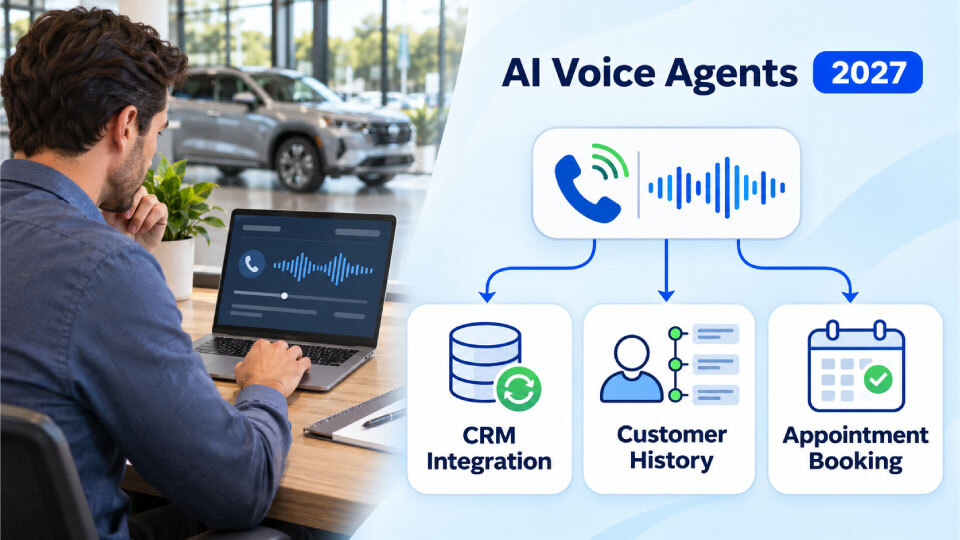
AI receptionists are likely to become more integrated into dealership communication workflows as voice technology and CRM integrations improve.
Here are some developments dealerships should pay attention to in 2027.
1. AI Receptionists Will Become More Context-Aware
Early automated phone systems primarily followed predefined scripts. Modern AI receptionists can understand conversational context and respond to follow-up questions.
The next step is connecting these conversations with dealership customer data.
For example, when an existing customer calls, an integrated system may be able to retrieve relevant information, such as their previous inquiry or scheduled service appointment, subject to proper data access and permissions.
2. Voice AI Will Become More Connected With CRM Systems
AI receptionists will increasingly operate as part of a broader dealership technology ecosystem. Instead of simply answering calls, they will connect customer conversations with CRM records, appointment systems, and follow-up workflows.
This will help dealerships maintain consistent customer information across different communication channels.
3. Human Handoffs Will Become More Important
As dealerships introduce more automation, customers will expect an easy way to reach a real employee. The ability to transfer calls without losing conversation context will become an important factor when choosing an AI receptionist.
Dealerships that make human assistance accessible can benefit from automation without sacrificing personal customer service.
4. AI Will Help Dealerships Capture After-Hours Leads
After-hours communication will remain an important opportunity for dealerships. AI receptionists can capture inquiries when sales representatives and BDC teams are unavailable. Rather than allowing calls to go unanswered, dealerships can collect lead details and arrange the next step.
5. Performance Measurement Will Shift Beyond Call Answering
Answering calls is only the beginning. Dealerships will increasingly need to evaluate whether their AI receptionist is generating qualified leads, booking appointments, and supporting actual sales and service outcomes. This means measuring conversion-related performance instead of focusing exclusively on call volume.
Frequently Asked Questions
Q1. Can I replace human receptionist with AI?
Yes, an AI receptionist can replace many routine receptionist responsibilities. However, completely replacing human employees isn’t ideal for every dealership.
Q2. Is an AI receptionist better than a human receptionist for dealerships?
An AI receptionist is better for 24/7 availability, immediate call answering, repetitive inquiries, and automated lead capture. A human receptionist is better for empathy, complex conversations, and personalized customer service.
Q3. Can an AI receptionist book dealership appointments?
Yes. An AI receptionist can book test drives, sales consultations, and service appointments when connected to a dealership’s scheduling system.
Q4. How much does an AI receptionist cost compared to a human receptionist?
The cost depends on the AI provider, call volume, software features, integrations, and usage fees to continue the service and improve technical performance. A human receptionist involves recurring employment costs such as salary, benefits, training, and AI receptionist typically involves subscription, setup, usage, and maintenance costs.
Q5. Will customers know they’re speaking with an AI receptionist?
Yes, and yes on purpose, because everyone has the right to know who they are talking to while making an appointment. An AI receptionist should clearly identify itself as an AI assistant at the beginning of the conversation.